
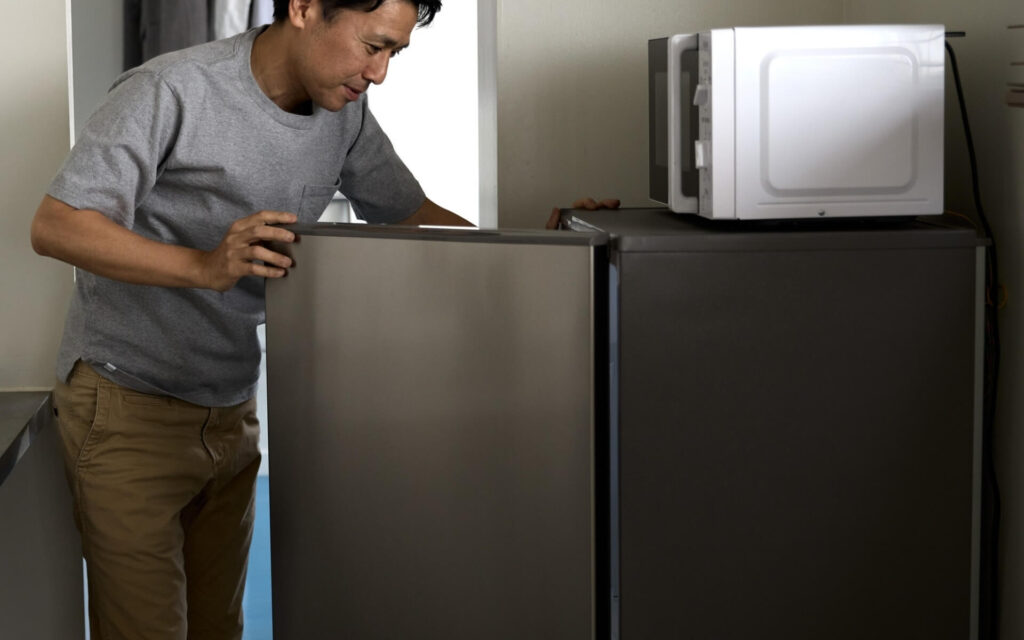
When a refrigerator suddenly stops cooling, the immediate reaction for most homeowners is pure panic. You open the door, notice the warm air, and instantly worry that the compressor is dead or that you are facing a massive repair bill for a replacement unit.
Before you start looking at new appliances or stressing over expensive mechanical failures, take a step back. The problem is often much simpler, safer, and far cheaper to fix than you think.
Step 1: Check the Power Source, Not the Appliance
The absolute first thing to check when your refrigerator stops working is the wall outlet and your home electrical panel, not the fridge itself.
A tripped circuit breaker, a loose plug, or a tripped Ground Fault Circuit Interrupter (GFCI) outlet is far more common than a sudden mechanical breakdown. An electrical issue completely cuts power to the unit before any internal component gets the chance to break.
How to Safely Test Your Power Source
Testing the power supply is simple, but safety must always come first.
- Unplug the refrigerator and plug a working lamp or phone charger directly into that exact wall outlet to see if it receives power.
- If the lamp fails to turn on, check your main circuit breaker box for a tripped switch.
- Look at nearby wall outlets for a tripped GFCI button and reset it, as refrigerator outlets are often wired on the same circuit.
- Keep your hands completely dry whenever touching plugs, cords, or outlets.
- Stop troubleshooting immediately if you see sparks, notice a burnt smell, or see water near the electrical area.
- Never stick metal tools, wire, or objects into an electrical socket slot.
Step 2: Inspect the Condenser Coils
If you have verified that the outlet has power and the fridge is getting electricity but still fails to cool properly, your next physical check should be the condenser coils.
Dirty coils are one of the leading causes of poor cooling performance. Over time, these coils collect heavy layers of dust, pet hair, and debris. Because the coils are responsible for releasing heat from inside the fridge, heavy buildup acts like an insulating blanket. Heat gets trapped, forcing the system to work overtime while cooling drops drastically long before any permanent hardware failure occurs.
How to Inspect and Clean Your Coils
- Locate the coils either at the bottom front behind the kickplate or along the back panel of the unit.
- Look for thick layers of pet hair, dust bunnies, or dirt blocking airflow around the wire framework.
- Gently clean the coils using a long-handled coil brush paired with a vacuum attachment to pull away loose debris.
- While you are there, quickly verify that your door seals are clean and sealing tightly, internal airflow vents inside the freezer are not blocked by food, and temperature dials have not been bumped accidentally.
The Biggest Misconception in Refrigerator Troubleshooting
In my experience, the biggest mistake homeowners make is assuming that a non-cooling fridge immediately points to a refrigerant leak or a dead compressor.
This misconception leads people to pay for expensive professional service calls or unnecessary system recharges when the real issue is much simpler. For instance, a failed defrost timer, a bad defrost heater, or blocked airflow can cause the evaporator coils inside the freezer to completely freeze over with ice. When that happens, cold air cannot circulate to the rest of the fridge. The compressor might be perfectly fine, but airflow is entirely choked off.
When to Stop Troubleshooting and Call a Professional
While basic power checks and coil cleaning are easy DIY steps, there is a clear line where troubleshooting stops and professional expertise is required. Continuing to run or test a damaged unit can turn a simple component repair into a complete system breakdown.
Stop troubleshooting and call a technician immediately if you encounter any of the following warning signs:
- A strong smell of burning wire, plastic, or insulation coming from the back or bottom of the appliance.
- Repeated clicking noises coming from a burning hot compressor that attempts to start every few minutes but fails.
- Any visible smoke or electrical sparks during operation.
- An electrical shock or tingling sensation when you touch the metal casing of the refrigerator.
- An oily residue around copper tubing, which indicates a sealed system refrigerant leak.